
bCasino How to Deposit
Every way to put money into a bCasino account from an Irish bank, what each one costs you in time, and the one card type the State now refuses outright.
The short answer
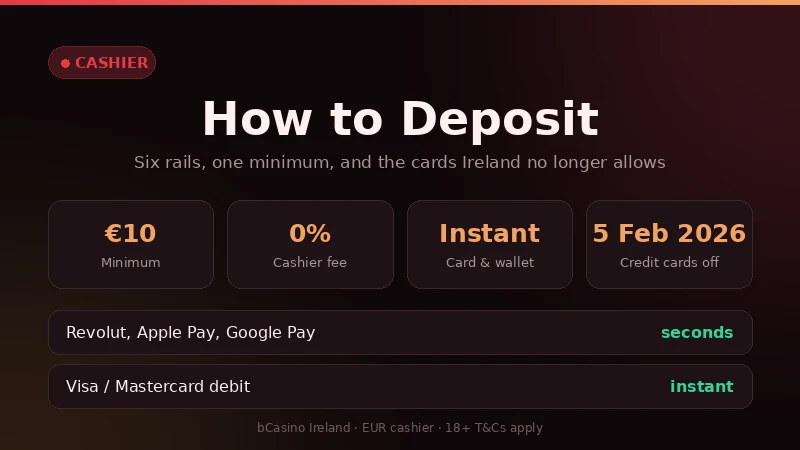
Open the cashier, choose Deposit, pick Revolut, a debit card, Apple Pay, Google Pay or an e-wallet, enter €10 or more and confirm. Everything except a bank transfer credits in seconds, the cashier charges nothing, and the welcome offer only triggers from €20. Credit cards are refused — they have been illegal for gambling in Ireland since 5 February 2026.
Paying money into bCasino from Ireland is genuinely quick — the awkward part is knowing which rail to use before you type an amount, because the choice you make on the way in decides how the money comes back out. Roughly half the popular deposit methods are structurally one-way. Nobody tells you that at the cashier. You find out a fortnight later when a payout you expected on your phone arrives as a bank transfer instead, two days late.
There is also a second thing worth getting straight before you start. Ireland changed the rules on gambling payments in early 2026, and the change is not a casino policy you can argue with. Credit cards are out. So is anything funded from credit — a wallet topped up from a credit card counts, and the processor can usually see that it was.
Everything below comes from an account we funded and drained ourselves through the spring and summer of 2026, with amounts and timings written down as they happened rather than as the terms page describes them. Where a figure has moved since we last checked, the date on the byline tells you when we looked.
Depositing, step by step
Sign in and open the cashier
It sits behind the balance figure at the top of the screen on desktop, and behind the wallet icon on mobile. Choose Deposit rather than the bonus tab — claiming an offer happens later in the same flow, not first.
Pick a method that can also pay you out
Debit card, Skrill, Neteller and bank transfer all work in both directions. Apple Pay and Google Pay do not. If you have any expectation of winning, choose from the first group — see the full table before you commit.
Enter the amount — and mind the €20 line
The cashier accepts €10. The welcome offer needs €20. A €10 first deposit is not an error message; it simply funds the account with no bonus attached, and there is no way to top it up afterwards and claim retroactively.
Approve the payment in your banking app
Irish debit cards trigger 3-D Secure almost every time — a push notification from AIB, Bank of Ireland, PTSB or Revolut. Approve it inside about two minutes. Letting it lapse produces a decline that looks identical to a bank block and sends people chasing the wrong problem.
Check the balance, then verify early
The money lands in seconds. Verification does not have to wait for your first withdrawal, and doing it now rather than then is the single biggest saving available on this page — see how bCasino verification works.
Set your limits in the same session
The cashier has deposit limits sitting one tab away from the deposit button. Setting a weekly ceiling takes fifteen seconds while you are calm and costs nothing; setting one after a bad night is a different exercise entirely. A limit you lower applies immediately, and a limit you raise takes effect only after a cooling-off period.
Debit cards: the default, and the one legal trap
A Visa or Mastercard debit card issued by an Irish bank is what most people use, and for good reason. Deposits arrive instantly, the card can receive a payout as well as send one, and the return trip is automatic — bCasino sends winnings back to the card the deposit came from, up to the amount you paid in, without asking for bank details.
The legal trap is credit. Since 5 February 2026, the Gambling Regulation Act 2024 has prohibited paying for gambling in Ireland with a credit card or any credit facility, and the prohibition explicitly extends to electronic payments funded from credit. This is not a bCasino rule and there is no version of asking nicely that gets around it. If your card number starts a transaction that the processor identifies as credit, the payment is refused at the gateway.
Two edge cases catch people out. A Revolut or N26 card drawing on a credit line behaves as credit even though the app looks like a current account. And a debit card belonging to someone else — a partner, a parent — fails at verification rather than at the cashier, usually weeks later when the first withdrawal is reviewed and the name on the card does not match the name on the account. That one costs the withdrawal, not just the deposit.
Practical detail: enter the card once and let the cashier tokenise it. Re-typing a full card number on every deposit raises the odds of a fraud-engine decline, because a repeated first-use pattern from the same account is exactly what card issuers are trained to look at.
Revolut, Apple Pay, Google Pay and the e-wallets
Revolut is the rail most Irish players reach for first, and it is a reasonable instinct — the payment authorises inside the app, the balance updates before you have put the phone down, and the money is already in euro. It also has a gambling block built into the app's security settings, which is worth knowing about in both directions: it is a genuinely useful tool, and it is also the reason a payment sometimes fails on an account where nothing else has changed.
Apple Pay and Google Pay are the fastest of the lot and the most limited. They authorise with a face or a fingerprint, they carry no card number across the wire, and they cannot receive money. A payout against an Apple Pay deposit falls back to the underlying debit card or to a bank transfer, which adds a day or two at the far end. Fine for a €20 deposit you expect to lose; irritating on a €500 one you do not.
Skrill and Neteller are the two-way workhorses. They take a step longer to set up than a card, they charge their own fees on the way out of the wallet into your bank rather than on the way into the casino, and they are still the fastest way to be paid — payouts to a wallet routinely land the same day where a card takes three. If you play more than occasionally, one of them is worth the twenty minutes it takes to open.
One rule worth internalising
Deposits made with an e-wallet very often cannot claim a welcome bonus. It is not bCasino being difficult — bonus abuse historically ran through wallets, and nearly every operator excludes them. Check the offer terms before you fund with Skrill or Neteller, not after.
Bank transfer and the SEPA timetable
A SEPA transfer from an Irish current account works in both directions and is the fallback the cashier reaches for whenever your deposit method cannot receive. Deposits by transfer take one to two working days to clear, which makes it a poor way to pay in and a perfectly good way to get paid. Use the reference the cashier generates, exactly as shown — a transfer arriving without it sits in a manual queue until somebody matches it by hand, and that is a support ticket rather than an afternoon.
Weekends matter here and nowhere else. Bank rails settle on working days, so a Friday evening transfer generally lands Monday and a Saturday payout request is not touched until the following week. Card and wallet deposits are unaffected — those are instant seven days a week, whatever else is happening in the banking system.
Which Irish bank you hold the account with changes the experience more than most people expect: AIB, Bank of Ireland, PTSB, Revolut, N26 and An Post Money all handle gambling merchants slightly differently, and two of them let you switch a block on and off yourself. We have broken that down bank by bank on the bCasino and Irish banks page.
Every deposit method, side by side
| Method | Minimum | Maximum | Speed in | Fee | Pays out? |
|---|---|---|---|---|---|
| Visa debit | €10 | €5,000 | Instant | None | Yes |
| Mastercard debit | €10 | €5,000 | Instant | None | Yes |
| Revolut | €10 | €5,000 | Seconds | None | Yes |
| Apple Pay | €10 | €2,500 | Seconds | None | No |
| Google Pay | €10 | €2,500 | Seconds | None | No |
| Skrill | €10 | €10,000 | Instant | None | Yes |
| Neteller | €10 | €10,000 | Instant | None | Yes |
| Trustly | €20 | €10,000 | Minutes | None | Yes |
| Paysafecard | €10 | €1,000 | Instant | Retail markup | No |
| SEPA bank transfer | €20 | €20,000 | 1–2 working days | None | Yes |
| Any credit card | — | — | — | — | Prohibited in Ireland |
Limits recorded from a verified Irish account in August 2026. Per-account maximums vary with your history and verification tier, and the cashier is always the final word.
Why a deposit gets declined
A declined deposit almost never means the casino refused you. It means something between your bank and the payment gateway said no, and there are six candidates. In every one of them the money stays in your account, whatever the screen implies — a pending line that vanishes within a few days is an authorisation hold, not a charge.
It was a credit card
The most common cause since February 2026, and the only one with no workaround. Check the card itself: Irish debit cards say Debit on the front. If it says Credit, that payment is not going through from any Irish account, at any casino.
Your bank has a gambling block switched on
Revolut and several Irish banks let you toggle this yourself, and some accounts ship with it on by default. Turning it off usually carries a cooling-off period of up to 48 hours — deliberately, so the switch is not something you flip mid-session.
The issuer declined merchant category 7995
Gambling transactions carry their own merchant code and some issuers refuse it as policy rather than per transaction. Nothing you change on your side fixes this; it needs a different card or a different rail.
Name mismatch
The name on the card must match the name on the bCasino account exactly. Third-party payments are refused everywhere in regulated gambling, and if one slips past the cashier it gets caught at verification instead, when far more money is on the line.
The 3-D Secure prompt timed out
Approve it within roughly two minutes. A lapsed prompt returns a generic decline that reads exactly like a bank block, which is why so many people spend an evening on the phone to their bank over a notification they simply missed.
A daily card limit
Both your bank and the cashier apply one. Several small deposits in an evening hit it faster than a single larger one, and the limit resets on the bank's clock rather than at midnight your time.
If a payment fails twice on the same method, stop and switch rails rather than retrying. Repeated attempts on a card the issuer has already refused are read by fraud engines as exactly what they look like, and the outcome is a longer block rather than a successful third attempt.
What it looks like on your bank statement
Not as the casino name. A bCasino deposit appears as a card purchase or transfer from an offshore payment processor — usually an abbreviated company name and a city, sometimes with a reference number attached, rarely with anything that says gaming. The descriptor changes from time to time as processors rotate, so a string you recognised in March may look different in September.
This has two practical consequences. First, reconcile by amount and date against the cashier history rather than by reading the merchant string — that is the only reliable match. Second, do not treat an unfamiliar descriptor as fraud before you check: raising a chargeback against a gambling deposit you actually made is the fastest route to a closed account and a forfeited balance, and it is close to impossible to unwind afterwards.
If you need a clean record — for a mortgage application, say — the cashier's own transaction export is the document to use. It is itemised, it carries dates and methods, and it is what a lender will understand rather than a page of rotating processor names.
Four things people believe that are not true
“A bigger deposit gets paid out faster.”
It is often the reverse. Larger withdrawals attract a manual review that small ones skip, so a €2,000 payout can take a day longer than a €200 one on the identical account and method.
“Depositing at an offshore casino is illegal for me.”
It is not. The Gambling Regulation Act 2024 places obligations on operators, not on players. The credit card prohibition is the one rule that binds the payment itself, and your bank enforces it before you get the chance to break it.
“Verification only matters when I withdraw.”
Technically true and practically backwards. Documents reviewed while you are still playing cost you nothing; the same documents reviewed with a payout waiting cost you two or three days of watching a Pending line.
“Winnings are taxed in Ireland.”
Not for a recreational player. Betting winnings are outside capital gains under section 613(2) of the Taxes Consolidation Act 1997, and there is no income tax, USC or PRSI on them either. What you keep is what arrives.
What Irish players report
“Revolut deposit was in the balance before I'd put the phone down. Took me a while to work out why the payout came back to my AIB card instead — turns out that's just how it works when you pay in from the app.”
Reader email, Dublin — 12 June 2026
“Card kept getting declined and I was raging at the casino. It was my own credit card. Switched to the debit one and it went through first time.”
Reader email, Galway — 3 April 2026
“Deposited €10 on the first go and missed the welcome bonus by a tenner. Support were grand about it but there was nothing they could do after the fact.”
Reader email, Cork — 27 July 2026
Frequently asked questions
How do I deposit at bCasino from Ireland?
Open the cashier, choose Deposit, pick a method, enter an amount of €10 or more and confirm. Revolut, Apple Pay, Google Pay, debit cards and e-wallets credit in seconds; a SEPA transfer takes one to two working days. The balance updates before the confirmation screen finishes loading on every method except bank transfer.
What is the minimum deposit at bCasino?
€10 on cards, wallets and instant rails, and €20 on a bank transfer because of how the receiving bank batches small amounts. The welcome offer needs €20 to trigger, so a €10 deposit funds the account but does not claim the bonus — a distinction that catches out more new players than any other rule in the cashier.
Can I use a credit card to deposit at bCasino?
No. Since 5 February 2026 the Gambling Regulation Act 2024 has prohibited credit cards and any credit facility as payment for gambling in Ireland, including wallet balances topped up from a credit card. Use a debit card drawing on your own money instead — it runs on the same Visa or Mastercard rail.
Why was my bCasino deposit declined?
In the order it actually happens: the card was a credit card, your bank has a gambling block switched on, the card issuer declined merchant category code 7995, the name on the card does not match the account name, you dismissed a 3-D Secure prompt, or you hit a daily card limit. In every one of those cases the money never leaves your account.
How does a bCasino deposit appear on my bank statement?
As a card purchase or transfer from an offshore payment processor, not as the casino name. The descriptor is usually an abbreviated company name plus a city, it changes from time to time, and it rarely mentions gaming. Match the amount and date against your cashier history rather than trying to read the merchant string.
Does bCasino charge a fee to deposit?
The cashier adds nothing at either end. What you can still pay is a Revolut or bank foreign-exchange spread if your account is not held in euro, a retail surcharge on a voucher bought over the counter, and in rare cases a foreign-transaction fee if your issuer routes the payment as overseas.
How long does a bCasino deposit take to arrive?
Seconds on Revolut, Apple Pay, Google Pay, debit cards and e-wallets — the balance is usually there before you close the payment window. A SEPA transfer takes one to two working days and does not move at weekends, which makes it a poor way to pay in and a perfectly good way to get paid.
Do I have to withdraw to the same method I deposited with?
Where the rail can receive money, yes. Anti-money-laundering rules require the return trip to go back the way it came, up to the amount you paid in. Apple Pay and Google Pay cannot receive, so deposits made that way are paid out to the underlying debit card or by bank transfer to an account in your own name.
Can I deposit at bCasino in euro?
Yes, and you should. The cashier holds balances in EUR, so a euro account moves money in and out with no conversion at all. Paying from a sterling or dollar balance adds a spread at both ends that you never see itemised — it simply arrives as a slightly smaller number than you sent.
Is depositing at bCasino legal in Ireland?
There is no offence in Irish law for a player who deposits at an offshore casino. The Gambling Regulation Act 2024 places its obligations on operators, not on you. What has changed is the payment side: the credit card prohibition binds anyone paying for gambling in the State, which is why a credit card is now refused rather than merely discouraged.
Keep reading
18+. Gamble responsibly. Minimums, speeds and available methods change without notice — the cashier is always the final word.